
Grant Deed vs. Deed of Trust: Understanding the Key Differences

Jennifer Park
Published: December 16, 2025 | Updated: December 16, 2025
In real estate, paperwork defines ownership, rights, and responsibilities. Two documents that often confuse homeowners and buyers are the grant deed and the deed of trust. Both are legal documents tied to property transactions, but they serve entirely different purposes. One transfers ownership; the other secures a loan. Understanding how they work — and how they relate to other common types of deeds — can help prevent costly mistakes when buying, selling, or refinancing property.
What Is a Grant Deed?
A grant deed is a legal document that transfers ownership of real property from one person (the grantor) to another (the grantee). It’s one of the most common types of deeds used in real estate transactions, particularly in states like California. When the grant deed is signed, notarized, and recorded, the property is transferred officially and publicly.
What a Grant Deed Guarantees?
A grant deed comes with two key assurances:
- The grantor owns the property and has the legal right to transfer it.
- The property is free from undisclosed encumbrances (liens or claims) that would affect the new owner.
Unlike a warranty deed, however, a grant deed doesn’t guarantee the property’s history before the current owner took title. In other words, it promises that the grantor hasn’t done anything to compromise ownership, but not that earlier owners were free of issues.
Key Elements of a Grant Deed
A valid grant deed typically includes:
- The names of the grantor and grantee
- A legal description of the property (address, parcel number, and boundaries)
- Language clearly stating that ownership is being transferred
- The grantor’s signature and notarization
- Recording information with the county recorder’s office
When this document that transfers ownership is recorded, it creates an official record proving who owns the property.
What Is a Deed of Trust?
A deed of trust is also a legal document, but it serves a completely different purpose. Rather than transferring ownership, it’s used to secure a loan on a property. It functions much like a mortgage but involves three parties:
- Trustor – the borrower
- Beneficiary – the lender
- Trustee – a neutral third party who holds the title until the loan is repaid
When a borrower takes out a mortgage, they sign a deed of trust to pledge the property as collateral. If the borrower defaults, the trustee has the power to sell the property through foreclosure on behalf of the lender.
How a Deed of Trust Works
- The borrower keeps the right to live in and use the property.
- The trustee holds the title as security.
- Once the loan is fully paid, the trustee reconveys the title to the borrower.
This makes the deed of trust a security instrument, not a document that transfers ownership.
Grant Deed vs. Deed of Trust: The Core Difference
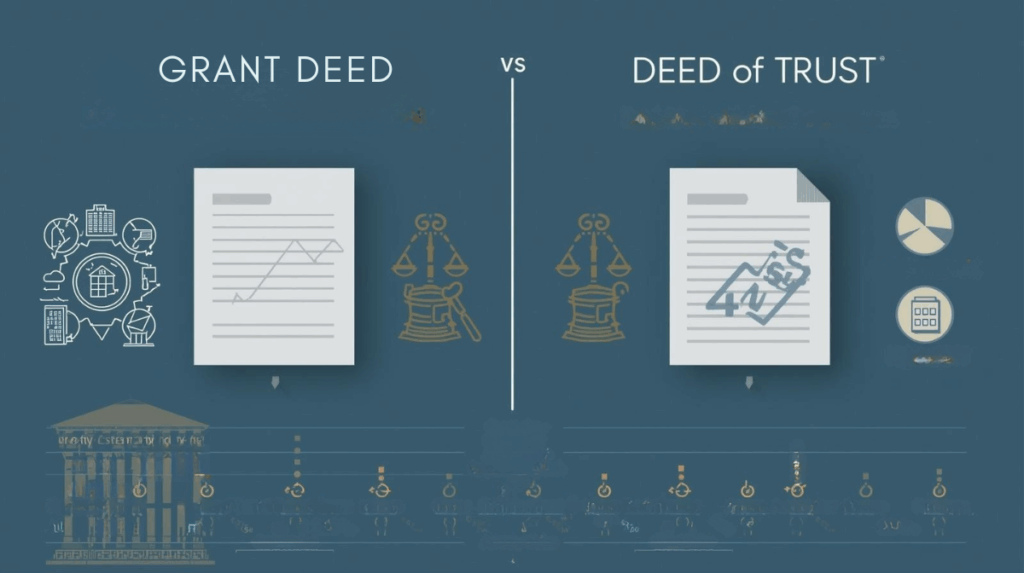
Although both are recorded with the county, a grant deed and a deed of trust operate in different stages of a real estate transaction:
| Feature | Grant Deed | Deed of Trust |
| Purpose | Transfers ownership from seller to buyer | Secures a loan for the property |
| Parties Involved | Grantor and Grantee | Borrower, Lender, Trustee |
| Guarantees | Ownership and no undisclosed encumbrances | Guarantees repayment to lender |
| When Used | When property is sold or gifted | When property is financed |
| Transfers Title? | Yes, to the buyer | No, title held by trustee until loan is paid |
| Type of Document | Conveyance | Security instrument |
In short: a grant deed transfers ownership, while a deed of trust secures repayment of a loan on that property.
Example: How a Grant Deed and Deed of Trust Work Together
Let’s say you’re buying a home in California:
- The seller signs a grant deed to transfer the property to you.
- You take out a loan to finance the purchase.
- You then sign a deed of trust with your lender, allowing the property to serve as collateral.
In this scenario, both documents are recorded — the grant deed shows that ownership was transferred to you, and the deed of trust shows that your lender has a claim on the property until the loan is paid off.
The Role of Deeds in Real Estate Transactions
Both documents are crucial for keeping real estate records accurate and legally enforceable.
- The grant deed ensures that ownership of real property is transferred cleanly.
- The deed of trust ensures that the lender’s investment is protected.
Together, they form the backbone of most real estate transactions, particularly in states that use deeds of trust instead of mortgages.
Other Types of Deeds You Might Encounter
Understanding the types of deeds helps clarify where the grant deed fits into the bigger picture:
- Warranty Deed: Offers the strongest protection for buyers by guaranteeing that the property has a clear title throughout its history.
- Quitclaim Deed: Transfers ownership interest without guarantees; often used between family members or in divorce settlements.
- Special Warranty Deed: Guarantees that the property was not encumbered during the seller’s ownership only.
- Bargain and Sale Deed: Used in certain states or commercial transfers, implying ownership but offering limited warranties.
Each deed is a legal instrument that serves a distinct function in property transfer or financing. Recognizing the difference can save you from confusion or unintended legal exposure later.
Recording and Legal Importance
Both the grant deed and deed of trust must be properly recorded to establish a public record. Recording protects the parties’ rights and ensures transparency in ownership and liens.
When the property is transferred via a grant deed, recording secures your claim as the new owner. When a deed of trust is recorded, it alerts anyone searching the property title that a lender has a financial interest.
Failing to record either document can lead to disputes or unclear ownership if multiple claims are filed.
What Happens After the Loan Is Paid Off?
Once the borrower has fully repaid the loan, the trustee issues a Deed of Reconveyance — another legal document that releases the lender’s interest and returns the title to the borrower. This step officially clears the lien and makes the homeowner the full legal owner without conditions.
Without this reconveyance, the lender’s claim remains in the public record, which can complicate future refinancing or selling.
Common Misunderstandings
- “A deed of trust transfers ownership.” False. It secures a loan, not ownership.
- “A grant deed guarantees the property’s entire history.” False. It only covers the seller’s period of ownership.
- “They can replace each other.” False. They serve different purposes and are both necessary in financed transactions.
When to Use Each Document
- Use a Grant Deed when property ownership changes hands — during a sale, inheritance, or family transfer.
- Use a Deed of Trust when financing or refinancing a property. It ensures the lender’s rights are legally protected until the loan is satisfied.
If you’re uncertain which document applies to your situation, consult a real estate attorney or title professional to review local requirements and ensure accuracy in every filing.
Summary: The Bottom Line
A grant deed is a document that transfers ownership of a property from one person to another. It’s a straightforward conveyance tool used in most property sales. A deed of trust, on the other hand, is a legal document that protects the lender by placing a lien on the property until the loan is paid off.
Both documents are essential in real estate — one ensures clean transfer of ownership, while the other ensures financial security for the lender. Understanding how they work, and when to use each, helps you navigate real estate transactions with clarity and confidence.